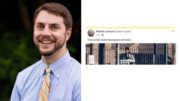
Chip Saltsman joins Joe Carr campaign

Chip Saltsman, a former Tennessee GOP chairman and manager of Arkansas Gov. Mike Huckabee’s presidential campaign, has joined state Rep. Joe Carr’s congressional bid as its “campaign director.”

Saltsman, who also managed U.S. Rep. Chuck Fleischmann’s campaigns in 2010 and 2012, will “manage all facets” of the Lascassas Republican’s 4th Congressional District campaign, a spokesman said. Carr so far faces incumbent U.S. Rep. Scott DesJarlais, R-South Pittsburg, and state Sen. Jim Tracy, R-Shelbyville.

“Chip brings significant firepower and experience to our campaign,” Carr said in a statement announcing Saltsman’s appointment. “His excellent track record of managing both statewide and national campaigns is invaluable.”

California Farmer Warns: “Don’t Trust Oil Industry, State or Courts” to Protect Water

By Dan Aiello

Kern County almond farmer, Fred Starrh, is an unlikely darling of the anti-fracking movement in California.

Hydraulic fracturing, or fracking, is an environmentally risky oil production method of pumping under pressure large volumes of water, sand and chemicals underground to bubble to the surface heavy tar-like oil left in depleted oil wells and to reach deep deposits of oil and natural gas.

Fracking is the method oil companies seek to employ to proliferate drilling in California where the discovered Monterey Shale Deposit is estimated to contain as many as 15.4 billion barrels of crude 11,000 feet deep.

read more

Study Ranks MD Number One State For Business Innovation Citing O’Malley Administration Initiatives As Catalyst For Growth

ANNAPOLIS, MD – The fourth annual Enterprising States report released by the U.S. Chamber of Commerce ranks Maryland number one in innovation and entrepreneurship and places the state third for talent preparation and workforce development. The Chamber of Commerce report points to measures championed by the O’Malley administration for the positive economic climate in the state. [...]

Is Your McDonald’s Cleaner than Your Abortion Clinic? In Iowa, We Don’t Know

Just as the shock and horror of the realities of the Kermit Gosnell infanticide trial begin to fade in our memories, we have begun hearing stories of other Kermit Gosnells in other parts of the country.

Abortionist Nicola Riley just had her medical license revoked in Maryland for a host of problems.  Like Gosnell, Riley kept the bodies of aborted babies in a freezer.  She has been on suspension since 2010 after she perforated the uterus of a woman during an abortion so badly that the woman’s bowels were spilling into her vagina, and body parts of the baby were later found outside of the uterus in the woman’s abdominal cavity.  Then, rather than call an ambulance to take the woman to a real medical facility, Riley drove the woman to the hospital in her own rental car.

Former employees have come forward with first-hand accounts of abortionist Douglas Karpen in Texas snapping the necks of babies born alive with his own hands.  Like Gosnell, Karpen has a history of receiving complaints that appear to not have been properly investigated by state officials.

So far, in Iowa, we’ve established that late-term third-trimester abortions are legal for just about any reason the doctor can dream up, and we’ve also established that there is at least one abortionist in Iowa who uses barbaric procedures very similar to those used by Kermit Gosnell when performing late-term abortions.

One of the things that has outraged people the most about the Gosnell situation is the fact that Pennsylvania state regulators allowed Gosnell to go on butchering women and children for years, ignoring complaints and skipping inspections with the blessing of pro-choice Republican governor Tom Ridge.

But could the Gosnell atrocities really happen in Iowa without state officials stepping and putting a stop to it?

Once again, the unfortunate answer to this question is yes, Iowa state officials would have no clue if these atrocities were happening within our own boarders.

The Iowa Republican contacted several state agencies asking the question of whether abortion clinics in Iowa are licensed or inspected.  We started with the Department of Public Health, but we were informed that, ironically, that department has nothing to do with regulating health facilities.

We were directed to contact the Iowa Department of Inspections and Appeals.  There, we were informed that abortion clinics are not subject to inspection in the state of Iowa.

The next logical question is, why not?  The short answer to that question is that, “[i]f  a facility, program, or service is not subject to state inspection[,] it is because there is no authority in Iowa law for conducing the inspections,” according to DIA spokesman David Werning.

The long answer to the question of what medical facilities are subject to certification, licensing, or inspection requirements involves a complicated analysis of whether the facility get reimbursements from Medicare, Medicaid, or whether state law specifically mandates inspections.

In regards to smaller medical facilities, Werning states, “Medical offices operated by physicians, including specialty clinics are not inspected by DIA.  In fact, I do not believe they are physically inspected by any state department.  Generally, physician offices and clinics are operated under the license of the physician and, therefore, may fall under the jurisdiction of the Iowa Board of Medicine – the licensing authority of physicians, surgeons, etc.”

To the average Iowan, it is somewhat mindblowing that facilities where surgical procedures, like abortions, are performed are never inspected.  Now, most other outpatient surgery centers (otherwise known as ambulatory surgical centers) are subject to inspection due to the federal certification required for facilities that receive certain federal funds.  But, even those inspections only happen every six years.

So, unless someone, like a woman who has had an abortion, wants to stand up and sign her name to a document making a formal complaint about a specific doctor to the state Board of Medicine, no one is ever going to do anything to make sure that abortion clinics are held accountable for violations that may be occurring.  The problem with this scenario is that women have abortions to hide the truth of what they are going through.  Putting their name behind a complaint and having to testify about the highly personal details of their lives just isn’t going to happen.

The other problem with that scenario is that during a surgical abortion, a woman is sedated and doesn’t know the details of what happened to her.  You can bet abortionists like Jill Meadows are going to do everything they can to make sure their patients don’t hear them literally tearing their babies apart.

So, what needs to happen to fix this problem and shut down filthy clinics (thereby saving babies in the process)?  The Iowa legislature needs to act to require abortion clinics adhere to the same requirements as outpatient surgical centers and also require regular inspections.  Several other states, including Pennsylvania, Virginia. Alabama, Kansas, and Texas, are doing just that.

The sad state of affairs in Iowa right now is that your local nail salon, barber, tanning salon, casino, carnival, and McDonalds are more regulated than your local abortion clinic.

We need a major adjustment in our priorities.  Otherwise, we have no right to be surprised outraged when yet another Kermit Gosnell comes to light, because we’ve done nothing to stop it.

Below is a listing of facilities that are currently inspected by the state of Iowa according to the Iowa Department of Inspections and Appeals.

Screen shot 2013-05-20 at 8.53.06 PM


Enhanced by Zemanta

The “New” California Republican Party Asks the Same Old Question

While a new California Republican Party chair might have more moves and different priorities than his predecessor, there’s no way to avoid the fact that the primary focus of the job is to elect more Republicans. GOP Chair Jim Brulte makes that point in Item #1 of the May 1 electronically-sent missive  below.

Electing more Republicans and, indeed, accomplishing Items #2 and #3, requires money. That, in turn, necessitates solicitations such as the one posted below, for campaign contributions. 

Nothing new about that. Brulte’s former colleague in the state senate, John Burton, does the very same thing as chair of the California Democratic Party. His job is made somewhat easy by his party holding the governor’s office and  super-majorities in both houses of the Legislature.

GOP-30-

What Kansas should do

As the Kansas Legislature struggles to end its 2013 session, budgetary and taxation issues remain to be resolved. It’s important that the legislature resolve these issues in a way that positions Kansas for economic growth, rather than retaining the policies that have led to stagnation compared to other states.

Personal income growth, Kansas and selected states, 2013

Here’s what the Kansas Legislature needs to do:

  • Keep the current sales tax rate.
  • Eliminate sales tax on food.
  • Reduce individual income and corporate income tax rates.
  • Get serious about reducing spending.

The legislature should reduce Kansas income tax rates by an amount that would be revenue-neutral, so that state spending does not grow. This moves Kansas towards more of a “Fair Tax” model, which many economists agree is better than taxing income. Elimination of the sales tax on food removes much of the regressive nature of the sales tax.

To the extent that the legislature believes it needs other funds, take it from transportation funding. We’ve spent a lot on roads and highways in recent years. It’s enough for now.

Another important thing the legislature needs to do is get serious about reducing government spending. Kansas lost an important chance to save money — although a relatively small amount — when school choice programs failed to pass. These programs, across the country, save state and local governments money. Unfortunately, Kansas legislative leaders did not use this argument.

Job growth, Kansas and selected states, 2013

How to save

In 2011 the Kansas Legislature lost three opportunities to save money and improve the operations of state government. Three bills, each with this goal, were passed by the House of Representatives, but each failed to pass through the moderate-controlled Senate, or had its contents stripped and replaced with different legislation.

Each of these bills represented a lost opportunity for state government services to be streamlined, delivered more efficiently, or measured and managed. These goals, while always important, are now essential for the success of Kansas government and the state’s economy.

One bill was called the Kansas Streamlining Government Act, another would have created the Kansas Advisory Council on Privatization and Public-Private Partnerships, and another would have created performance measures for state agencies and report that information to the public. More information on these bills is at Kansas budget solution overlooked.

We have to wonder why these bills — or similar measures — were not introduced and advanced this year when the opposition in the Senate is weaker. These are the types of measures we need to take as a state.

What Kansas should do

As the Kansas Legislature struggles to end its 2013 session, budgetary and taxation issues remain to be resolved. It’s important that the legislature resolve these issues in a way that positions Kansas for economic growth, rather than retaining the policies that have led to stagnation compared to other states.

Personal income growth, Kansas and selected states, 2013

Here’s what the Kansas Legislature needs to do:

  • Keep the current sales tax rate.
  • Eliminate sales tax on food.
  • Reduce individual income and corporate income tax rates.
  • Get serious about spending.

The legislature should reduce Kansas income tax rates by an amount that would be revenue-neutral, so that state spending does not grow. This moves Kansas towards more of a “Fair Tax” model, which many economists agree is better than taxing income. Elimination of the sales tax on food removes much of the regressive nature of the sales tax.

To the extent that the legislature believes it needs other funds, take it from transportation funding. We’ve spent a lot on roads and highways in recent years. It’s enough for now.

Another important thing the legislature needs to do is get serious about reducing government spending. Kansas lost an important chance to save money — although a relatively small amount — when school choice programs failed to pass. These programs, across the country, save state and local governments money. Unfortunately, Kansas legislative leaders did not use this argument.

Job growth, Kansas and selected states, 2013

How to save

In 2011 the Kansas Legislature lost three opportunities to save money and improve the operations of state government. Three bills, each with this goal, were passed by the House of Representatives, but each failed to pass through the moderate-controlled Senate, or had its contents stripped and replaced with different legislation.

Each of these bills represented a lost opportunity for state government services to be streamlined, delivered more efficiently, or measured and managed. These goals, while always important, are now essential for the success of Kansas government and the state’s economy.

One bill was called the Kansas Streamlining Government Act, another would have created the Kansas Advisory Council on Privatization and Public-Private Partnerships, and another would have created performance measures for state agencies and report that information to the public. More information on these bills is at Kansas budget solution overlooked.

We have to wonder why these bills — or similar measures — were not introduced and advanced this year when the opposition in the Senate is weaker. These are the types of measures we need to take as a state.